
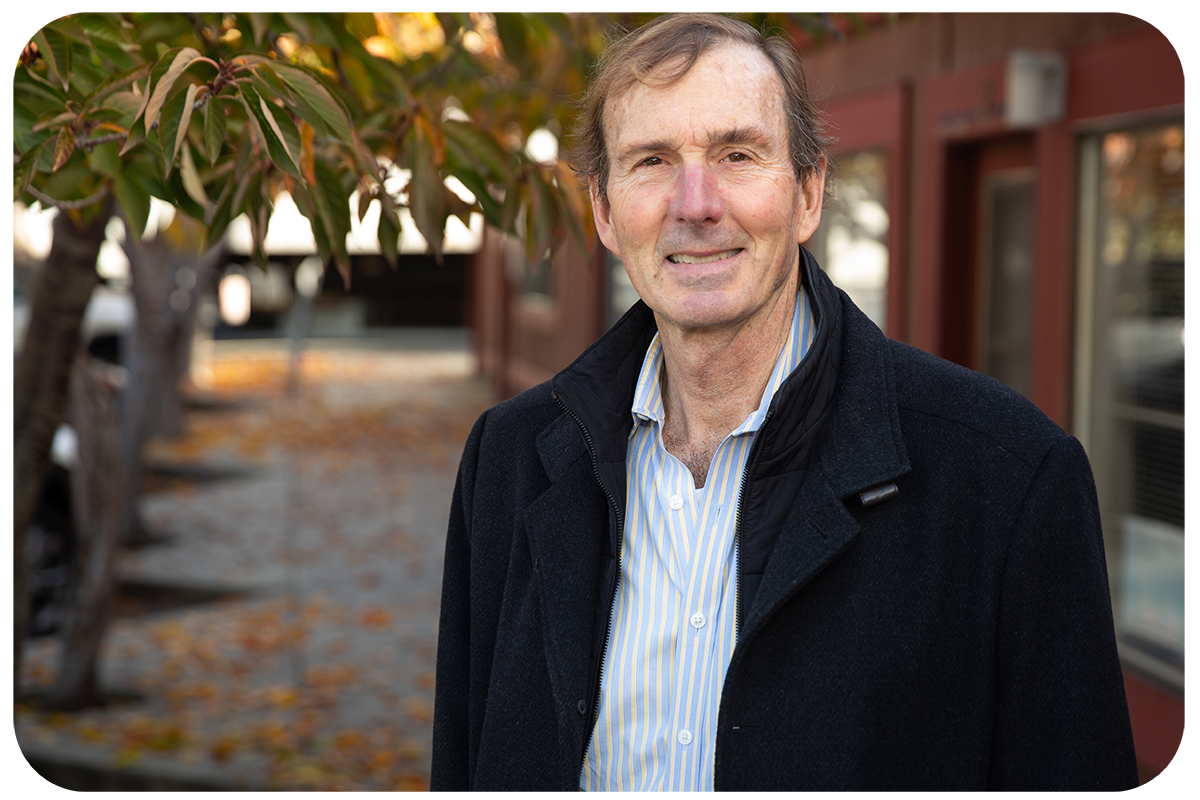
On a crisp morning in early December, I’m walking with John Montgomery from our offices located at the Creamery (and Creamery Annex) in Point Reyes Station over to Toby’s to soak up some sunshine and hold an interview over coffee. John is tall, fit (still swims regularly across Tomales Bay), and has light-brown hair combed to the side. As we walk, he greets the folks he knows, which seems to be about everybody!
Prior to moving to West Marin, he led a successful corporate law practice in the South Peninsula and is the author of the books Great from the Start: How Conscious Corporations Attract Success and Net Zero Business Models: Winning in the Global Net Zero Economy. Over the last few years, John has operated a private coaching practice for corporate leaders through his leadership consulting firm, Center for Global Consciousness. John has historically shared the proceeds from his coaching business with the community and is one of West Marin Senior Services’ top business sponsors.
It’s great to catch up, and the hot drink is keeping my hands warm, but it’s cold outside, even in the sunshine, so we get started with the interview.
Q: John, thank you for meeting with me. You’re an East Coast transplant; you grew up in a rural area, had a career in the South Bay, and now, you live in a rural area again. Is this coming full circle?
A: I grew up in a very small town in New York: Katonah, New York. It’s about 50 miles north of New York City, and I think its population is similar to West Marin. It’s a rural community. It was much more rural when I grew up than it is now, and it was a very diverse community. We had the New York State women’s prison, the maximum-security prison for women, at the end of the road that I grew up on. And we had tradespeople, teachers, firemen, and policemen, and all of that. Then we had a lot of mostly men who commuted by train into New York City to executive jobs.
It was a small town, rural, and I feel like I’ve come full circle. Being out here in West Marin, it’s very similar to my childhood. I’m very comfortable in the slower pace of life and being in nature. I grew up on a remnant of the John Jay Homestead; John Jay was one of the signers of the Declaration of Independence and a past governor of New York. I grew up on a remnant of his farm, and so I feel very much at home in West Marin.
Q: Leadership is usually equated with success. How do you see leadership? And what does it mean to you to be a successful leader?
A: Well, I think there are levels of leadership. I think you have people like our current president, who’s modeling one style of leadership, which tends to be power-over and fear-based. What I think is a much more effective type of leadership is one that is love-based. It’s from the heart, where you’re not exerting power over people; you’re empowering others. It’s kind of the benevolent king archetype, where your job is not to have the most subjects (i.e., the most power), but to lead the most people to royalty.
In the language of self-actualization, your job is to create a safe container for people to be their best selves. Ultimately, that’s the job of a leader: to create a safe, loving, container that’s supportive of peak human performance. Because the neuroscientific research shows that when we humans work in an environment where we’re loved and trusted, we’re twice as productive. We’re twice as happy, and we have half the employee turnover in that kind of work environment. And more importantly, when we’re in an environment where we’re loved and trusted, we optimize the probability that we can engender a collective flow state, which is endemic of peak human performance.
Q: What challenges do you see in West Marin and rural America in general? And what role do you see for our local leaders?
A: Well, I think one of the things that’s quite striking about West Marin is the lack of local government. We have a collection of hamlets. The hamlets do not have mayors; they don’t have city councils. So this community tends to be organized much like the traditional volunteer fire department that I grew up with in New York state, where it’s up to us in the community to create the infrastructure to support the community.
I often refer to West Marin as the “Free Republic of West Marin,” because I know people here are very engaged. The non-governmental organizations are extremely important. The Dance Palace, for example, is our de facto community center in West Marin (and) operates independently as an NGO. The work that West Marin Senior Services does is extremely important because there’s an aging rural community. And we elders, we start suffering the indignities of age as our body parts wear out and we move towards our appointment with our Maker.
These community organizations and their leaders are extremely important in this community, and I think they provide an example for rural America, not only rural America, but for the rest of the country. When you look under the hood with the U.S. government, we’re probably bankrupt. Our debt is enormous; we may have to deal with less government service, and what does that mean? Well, it means that we, the people, are going to have to step up and fill that vacuum. What’s beautiful about West Marin: is we’re already doing that. It’s part of the fabric of this place, and that’s one of the things that makes this place really special!